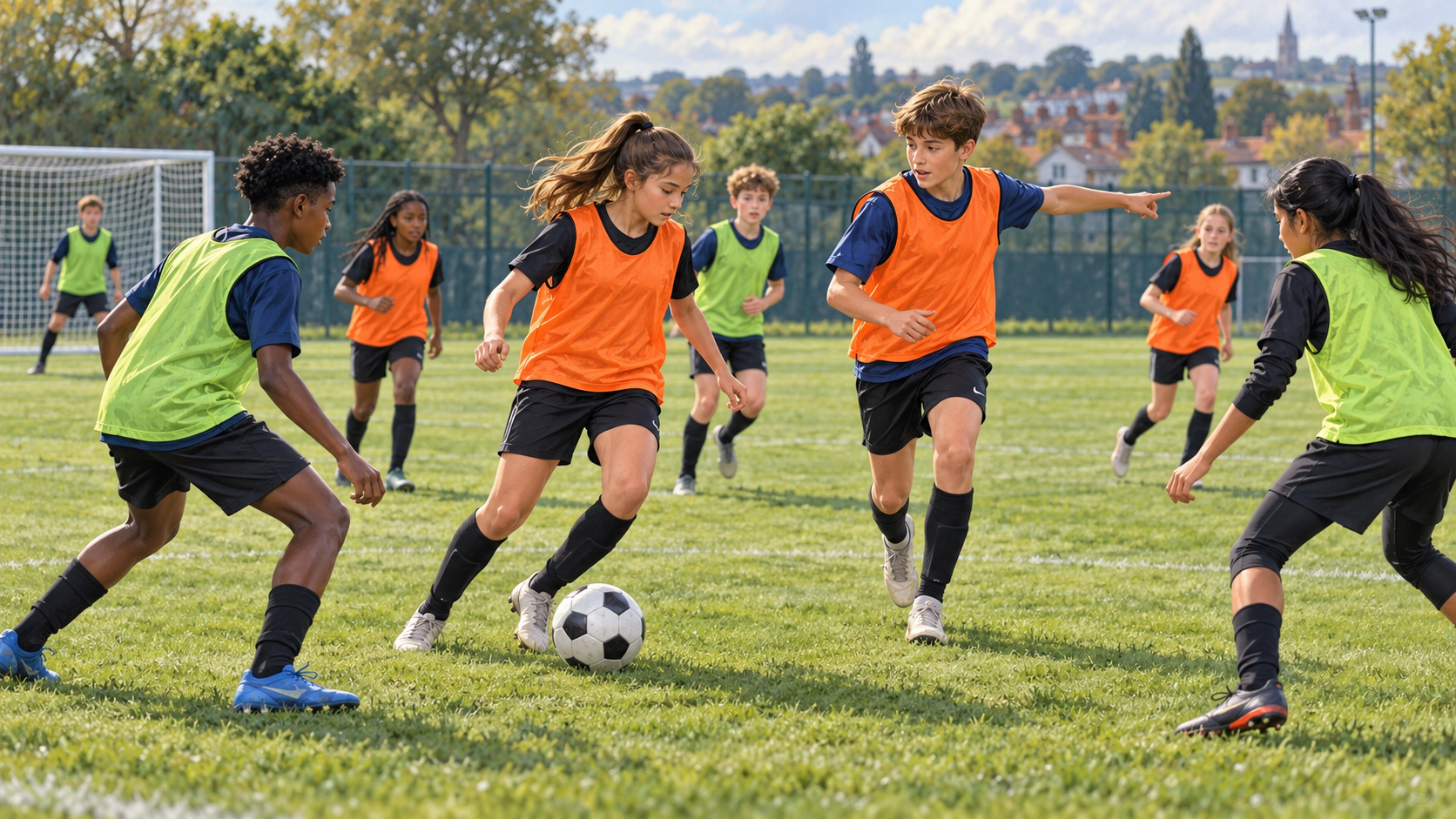
The player who wins the race to the ball is easy to notice. The player who understood the next pass before the race began can be easier to miss. A youth coach needs to see both, especially when physical differences make one contribution more visible than another.
Selection and development depend on a difficult distinction: how effectively a youngster performs today, and what that performance tells us about their capacity to improve. A good decision acknowledges the first without pretending to know the second with certainty.
Separate the questions before judging the player
Relative age and biological maturation describe different things. Relative age concerns where a birthday falls within an age-grouping period. Maturation concerns progress towards the adult state. Being younger within a squad does not establish that a player matures later, and looking small does not provide a maturity assessment.
FIFA's discussion with Professor Sean Cumming explains how differences in maturation can influence performance and selection, particularly when early physical development offers an advantage over age-matched peers. The coaching implication is to interpret performance in context, rather than read physical superiority as a complete account of football ability. FIFA's maturation discussion
There is no need to turn every session into a prediction exercise. A more useful question is: what opportunities does this player need next, and what evidence would help us make a better decision?
Write observations that another coach can challenge
Consider two under-14 players. One regularly carries the ball beyond opponents. Another receives in useful spaces but struggles when an opponent closes quickly. Writing “powerful” beside the first and “not ready” beside the second tells the next coach very little.
A better record describes the situation. Did the carrier recognise when a pass would release a team-mate earlier? Did the receiver notice pressure before the ball arrived? What happened when the same player faced different opponents or played another role? These are questions to investigate, rather than personality labels.
The FA's interview with Richard Allen highlights the distinction between performance and potential, and the need to consider factors including relative age, maturation and individual circumstances. That wider view should improve the questions in an observation record, not merely add another heading to a form. The FA on identifying potential
Record the task and its demands alongside the response. A player who rarely received the ball has not supplied the same evidence as a player who repeatedly faced the decision being assessed. Absence from the action can reflect the environment as well as the individual.
Change the observation opportunity
For a proposed observation session, choose one football question: how does a player create a useful receiving position? Watch it in a small game, revisit it with different team-mates, and observe it again in a larger game. Keep the football problem recognisable while changing the surrounding demands.
Give the physically dominant player a demanding decision to solve. Can they attract an opponent and release a team-mate? Can they recognise when carrying remains the best choice? Asking these questions gives their current strength a more complete football context.
Give a player who is being crowded out a genuine opportunity to participate. Adjust space, team balance or the immediate task, then watch whether they use the opportunity intelligently. The adjustment is a way to gather information and support learning. Success in the adjusted game is one piece of evidence, not proof of future senior performance.
This approach should benefit the whole group. It avoids assuming that a bigger youngster needs no support or that a smaller youngster automatically possesses hidden potential.
Awareness must change decisions
A qualitative study interviewing six coaches working in Norwegian academy or regional football found awareness of the relative age effect, but few reported ways of reducing its impact in their identification process. The study examined coaches' accounts; it did not validate a formula for predicting future players. Its useful challenge is practical: what changes when a coach recognises a possible bias? The original coaching study
One answer is to review a decision with another coach before making it permanent. Ask which observations support the judgement, which remain uncertain, and whether the player has had a fair opportunity to demonstrate the relevant qualities. Repeat that conversation over time. A second opinion is most useful when it tests the evidence rather than simply confirms the first impression.
Use specialist information within its proper limits
Bio-banding offers another perspective in some academy environments. A study involving 115 boys from three professional academies examined players' experiences of a maturity-matched tournament. Participants described different challenges and opportunities to express themselves. These were perceptions of a particular event, not evidence that one grouping method guarantees development or prevents injury. The original bio-banding study
It does not follow that a grassroots coach should estimate puberty or invent maturity groups from appearance. Where specialist assessments are available, qualified staff should explain their methods, limitations and appropriate use. The coach still needs to understand the young person and the football being observed.
With younger children, protect varied involvement and resist early fixed labels. With adolescents, make changing demands and support needs part of regular review. At every stage, explain decisions respectfully and leave room to revise them.
The aim is a better development decision today, made with enough humility to change tomorrow. A player's present physical advantage deserves recognition. Their future deserves a wider view.
A thought worth keeping?