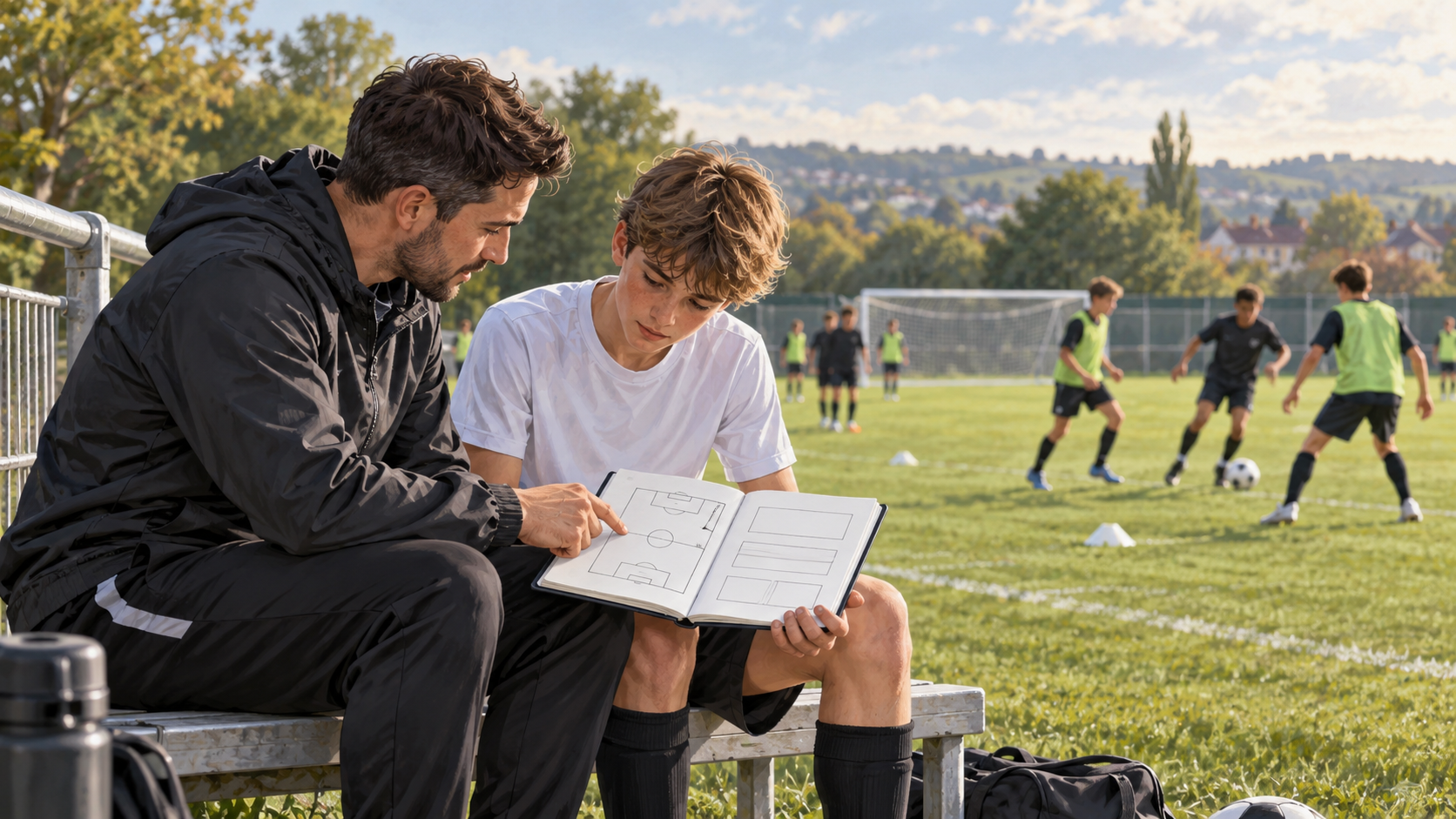
A team can look well organised while the coach is supplying every decision. The players move when told, pass when told and wait for the next instruction. It may produce a tidy spell of football. It leaves an important performance question unanswered: what happens when the instruction does not arrive?
Matchday offers a chance to see whether learning travels beyond the training exercise. A young player has to recognise a situation, choose an action and respond when the picture changes. The coaching task is to prepare that thinking, support it under pressure and review it honestly afterwards.
Carry one training problem into the game
The FA's development-game framework connects planning, delivery and review. A fixture sits within a longer learning process, with objectives informed by previous practice and evaluated afterwards. That is a useful discipline even when a community team has one coach and very little preparation time. The FA's Plan, Do, Review framework
Choose a problem that players have actually explored. If training has focused on supporting the player in possession, keep that connection visible. Ask the group what a useful supporting position lets a teammate do. Agree a simple cue, then let the match present different versions of the problem.
This avoids turning the pre-match talk into a new lesson. A list of unfamiliar instructions adds noise precisely when players need a clear starting point. A shared intention gives the coach something specific to observe and the players something they can recognise.
The FA's player-centred matchday guidance makes a related distinction: success should reflect individual learning as well as the result, and challenges should concern actions the player can influence. A demand to score a particular number of goals depends on teammates, opponents and opportunity. A challenge about noticing support options is more useful to the learner. Player-centred matchday guidance
Give ownership a manageable boundary
Ownership is not the same as leaving children to manage everything. Adults remain responsible for safety, fair treatment and the competition's requirements. Inside those boundaries, players can have meaningful choices.
England Football Learning recommends adjusting ownership to age and experience. Younger or less experienced groups may start with a small choice; older players who are ready for more responsibility can contribute to learning objectives and matchday decisions. The essential test is whether the coach listens and makes use of their contribution. How to give players ownership
For an under-10 group, that might mean choosing the words for a team reminder. For an under-14 group, it could mean discussing two ways to support a teammate who receives under pressure. These are examples to adapt, not age-based tests that every child must pass. A quiet player may need a paired conversation before speaking to the whole group.
Do not turn selection into a popularity vote or ask players to assess one another publicly. Ownership should increase their understanding and contribution. It should not transfer adult responsibilities or expose a child to avoidable embarrassment.
An illustrative matchday observation
Suppose an under-13 team has been practising how to help a teammate play away from pressure. Before the match, the players identify two useful actions: moving into a visible passing lane and offering another option if the first lane closes. Each player chooses one action to pay attention to.
The coach then observes a small number of relevant moments rather than counting every successful pass. A note might read: “Receiver checked away from pressure; supporting player moved late; pass was intercepted.” Another might read: “Support arrived early; receiver chose to carry into open space.”
Neither note is a verdict on the player. Both describe a situation that can be discussed. The interception does not prove the idea was wrong; the successful carry does not make the support movement irrelevant. Decisions, execution and the opponent's response need separate attention.
At a natural break, invite players to describe what they saw. Ask one question about the agreed problem and listen before offering an explanation. Then agree one adjustment they can try. This keeps the conversation attached to the game rather than becoming a public examination of who remembers the coach's preferred answer.
Keep the touchline consistent with the learning
Encouraging independence in training and directing every action at the weekend sends conflicting messages. Players soon learn which message carries more weight.
England Football's coaching-impact guidance recommends linking matchday messages to training, encouraging attempts that do not immediately succeed and using half-time questions to draw out players' understanding. It also suggests focusing observation rather than trying to track everything. Understanding coaching impact
The practical implication is to decide what requires immediate communication. A safety concern or an organisational misunderstanding may need a clear instruction. A football problem that players can explore may need time. Silence is useful when it protects that exploration; it is unhelpful when a player needs support and receives none.
Agree the approach with other adults before kick-off. Parents and assistants should know the learning focus and understand why the coach may allow a difficult moment to continue. A calm explanation before the game is easier than trying to negotiate competing instructions across the pitch.
Review the coaching decision too
Afterwards, ask players for an example that helped them understand the problem. Add one observation, then identify a useful next practice. The review should produce a coaching action: perhaps a more demanding opponent, a clearer demonstration or more chances for a particular player to recognise the situation.
The coach also needs scrutiny. England Football's self-reflection guidance asks coaches to compare their behaviour with their values and seek other perspectives. A coach who says players should think independently can therefore ask whether their own communication made that possible. Self-reflection in coaching
The score remains part of a competitive game. It should sit alongside evidence of how players understood and responded to its demands. That makes the next training session more precise, and it keeps the ambition for performance connected to the development of the person making the decisions.

A thought worth keeping?