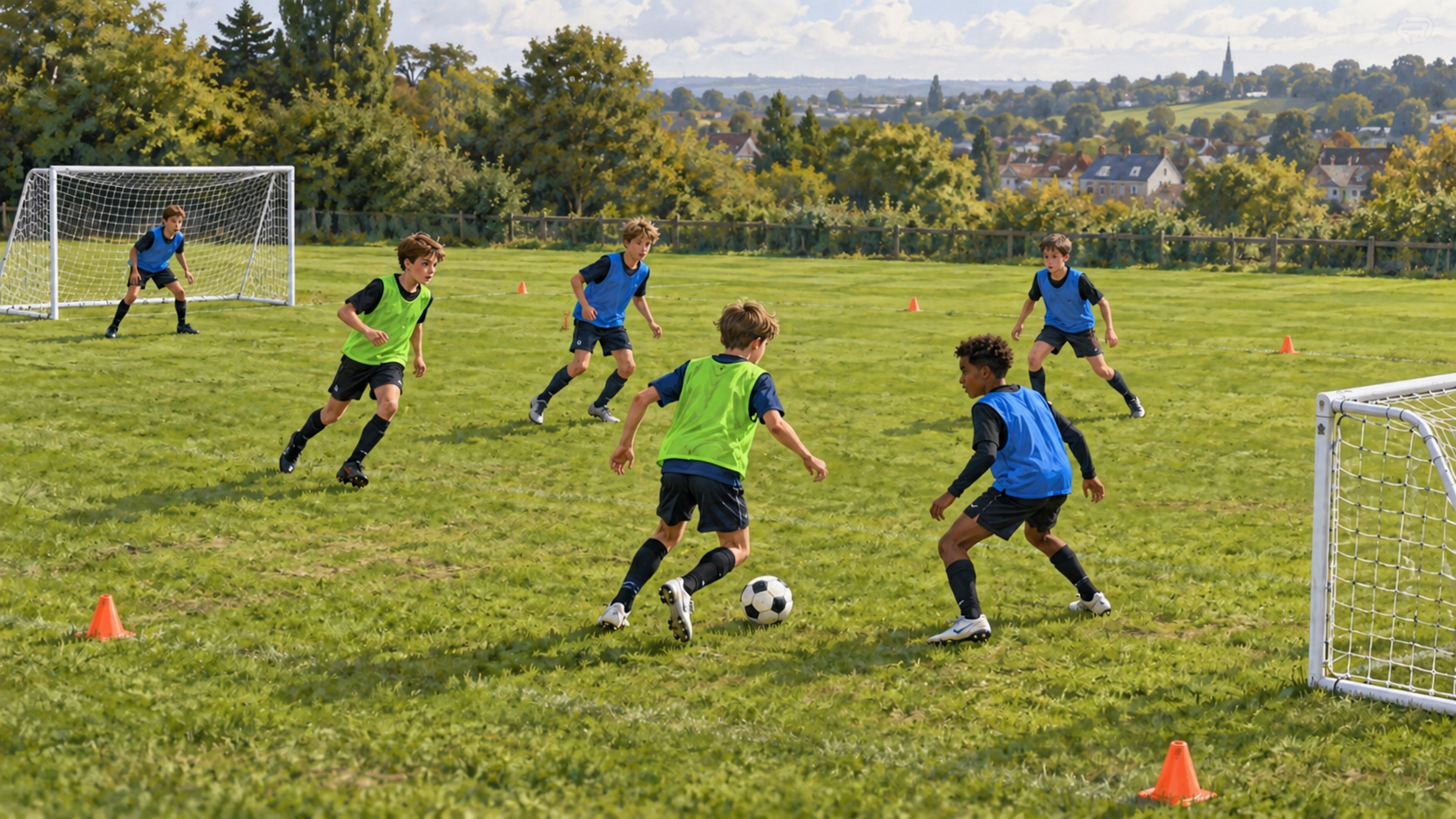
A small-sided game can keep everyone busy without teaching the intended lesson. The ball moves, players compete and the session looks lively. The harder question is whether the design repeatedly presents the football decision the coach wants players to explore.
For players aged roughly nine to twelve, practice design should make the problem available often enough to investigate, while preserving a genuine choice. If every action is dictated by a condition, the coach may have organised a successful routine and removed the very judgement the game was supposed to develop.
Name the problem before moving the cones
England Football Learning advises coaches to begin practice design with a clear intended outcome and use that outcome as the focus for observation. It also emphasises the relevance of direction, opponents and scoring to an invasion game. The FA's practice-design guidance
Take a transition theme: after losing possession, can the nearest player recognise whether to challenge or recover into a useful defending position? This is more informative than announcing that the session is “about working harder”. Effort matters, but effort without a reading of the situation can send several players towards a ball they cannot win.
The coach therefore needs a game in which possession changes, opponents can exploit the change and defenders have choices. A line of players performing an identical recovery run might rehearse a movement. It would leave important parts of this particular problem absent.
Build a simple game, then watch what it creates
One proposed starting point is three against three, with each team attacking two mini-goals at the opposite end. Use securely anchored goals, a safe playing surface and clear run-off space. A rectangle around 28 by 20 metres could be a first trial for some groups; it is a coaching adjustment point, not an age-based requirement.
Play with ordinary goals and quick, organised restarts. Arrange short bouts with appropriate breaks, and rotate opponents rather than leaving a fixed hierarchy of stronger and weaker teams. Keep spare balls clear of the playing area until needed.
The multiple-goal idea has a useful published reference. FIFA's analysis of three-against-three Funino explains how alternative goals can draw attention to space and the decision to progress or switch the attack. The design creates possibilities that players must recognise, rather than a compulsory passing sequence. FIFA's analysis of the Funino format
For the transition theme, observe the first few moments after a turnover. Is the nearest defender close enough to affect the receiver? Are teammates protecting another route to goal? Does the new attacking team recognise an open target? The game offers information to both sides, so the coach should avoid reducing every turnover to one shouted instruction.
Adjust the difficulty without writing the answer
If possession changes so rapidly that nobody can look up, create more usable space or temporarily help the team with the ball through an additional support player. If attackers repeatedly score without having to change their route, bring the challenge closer to their current capability. Change one feature, then observe again.
The practice spectrum is useful here. The FA distinguishes activities that isolate technique from those that add interference, numerical advantage or matched opposition. Each offers a different learning opportunity. Moving between them should answer a player's need, rather than follow a belief that one format is always superior. The FA's practice spectrum
Suppose one child repeatedly loses the ball because receiving it while moving is still unfamiliar. A brief technical rehearsal with a partner may help clarify the contact and body position. Bring that player back into an appropriately supported game to explore when and how to use the action. The technical work and the game answer related questions.
Be cautious about adding a condition merely because a game appears untidy. A universal two-touch rule may hurry a player who still needs time to control and look. A compulsory pass before scoring may prevent a sensible dribble into an open goal. Before imposing either, explain which problem it is intended to solve and watch for the choices it removes.
Look beyond the player who wins the ball
An observation sheet can stay very small. For several turnovers, note where the nearest defender began, whether an immediate challenge was realistic and how the next teammate helped. Include an example in which recovery was the useful choice. Otherwise the records may reward only dramatic tackles.
Also notice who is repeatedly absent from the action. A game can give one confident player many decisions while giving another very few. Adjust team combinations, space or support so that everyone encounters a worthwhile challenge. A quiet player should not disappear behind an encouraging team score.
Ask the players what made a turnover difficult to respond to. Their answers may reveal a feature the coach missed: a confusing restart, a goal they could not see, or too little time to recognise the new direction. Those are design issues as well as player issues.
Remove the condition and check again
Finish with a less constrained game in the format appropriate to the group. Keep the observational theme but reduce the reminders. Do players still recognise when to challenge and when to recover? Do their teammates respond together?
One session cannot establish durable learning. It can produce useful evidence for the next session, especially when the same decision is observed again in a different game. The strongest practice design leaves the coach with a clearer account of what players understand and leaves players with more opportunity to make that understanding work.

A thought worth keeping?